

FYJ Launches New AI-Powered Omni-Eye RFID Gate with Plug-and-Play Deployment

FYJ has launched a new AI-powered Omni-Eye RFID Gate, designed for more accurate RFID entry and exit recognition in dynamic multi-tag environments.
The new system combines AI algorithms, phase trajectory recognition, multi-tag processing, narrow-beam antennas, and edge computing to determine whether RFID-tagged items have actually crossed a monitored boundary.
Unlike conventional RFID gates that rely mainly on signal strength, the Omni-Eye RFID Gate analyzes the actual phase movement trajectory of RFID tags in space. This helps the system distinguish real entry and exit movement from surrounding RFID signals, while reducing cross-reading and unnecessary alarms.
One of the key advantages is simpler deployment:
Install it, power it on, and start using it — without repeated onsite parameter tuning.
The new FYJ Omni-Eye RFID Gate is built around five practical upgrades:
It also adopts a slim ceiling-mounted design that keeps the passage clear and reduces floor-space requirements.
A common challenge with traditional RFID gates is that signal strength alone cannot always tell whether a tag is simply nearby or has actually moved through the entrance.
The Omni-Eye RFID Gate uses spatial phase trajectory recognition instead.
By analyzing how the RFID tag moves through the monitored area, the system can identify its entry or exit status based on the movement process itself rather than only on received signal strength.
The system supports:
It does not require infrared, radar, or visual sensing to determine tag movement direction.
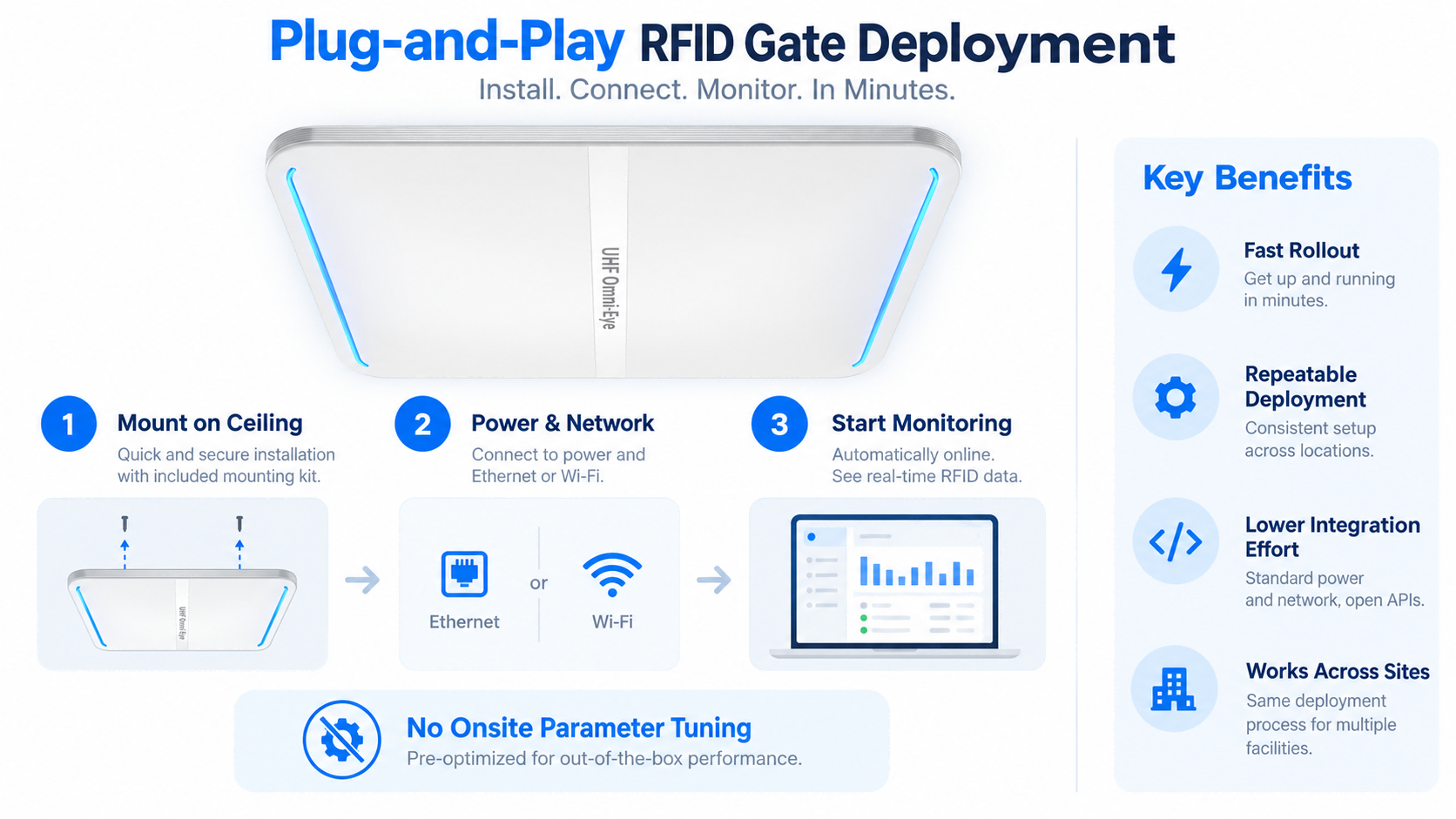
This is one of the most important upgrades.
Traditional RFID access control systems may require technicians to repeatedly adjust parameters according to:
The FYJ Omni-Eye RFID Gate reduces this dependency by using the tag's movement trajectory itself as the basis for entry and exit recognition.
That means the device can be installed and put into operation without repeatedly fine-tuning parameters for every new environment.
In the published test process, the device was installed and tested directly without additional parameter adjustment.
For customers or system integrators deploying RFID gates across multiple sites, this can make installation and project rollout much simpler.
Install → Connect → Start Monitoring
No repeated onsite tuning.
No need to rebuild recognition logic for every new entrance.
That makes the system better suited to standardized, repeatable RFID deployments.
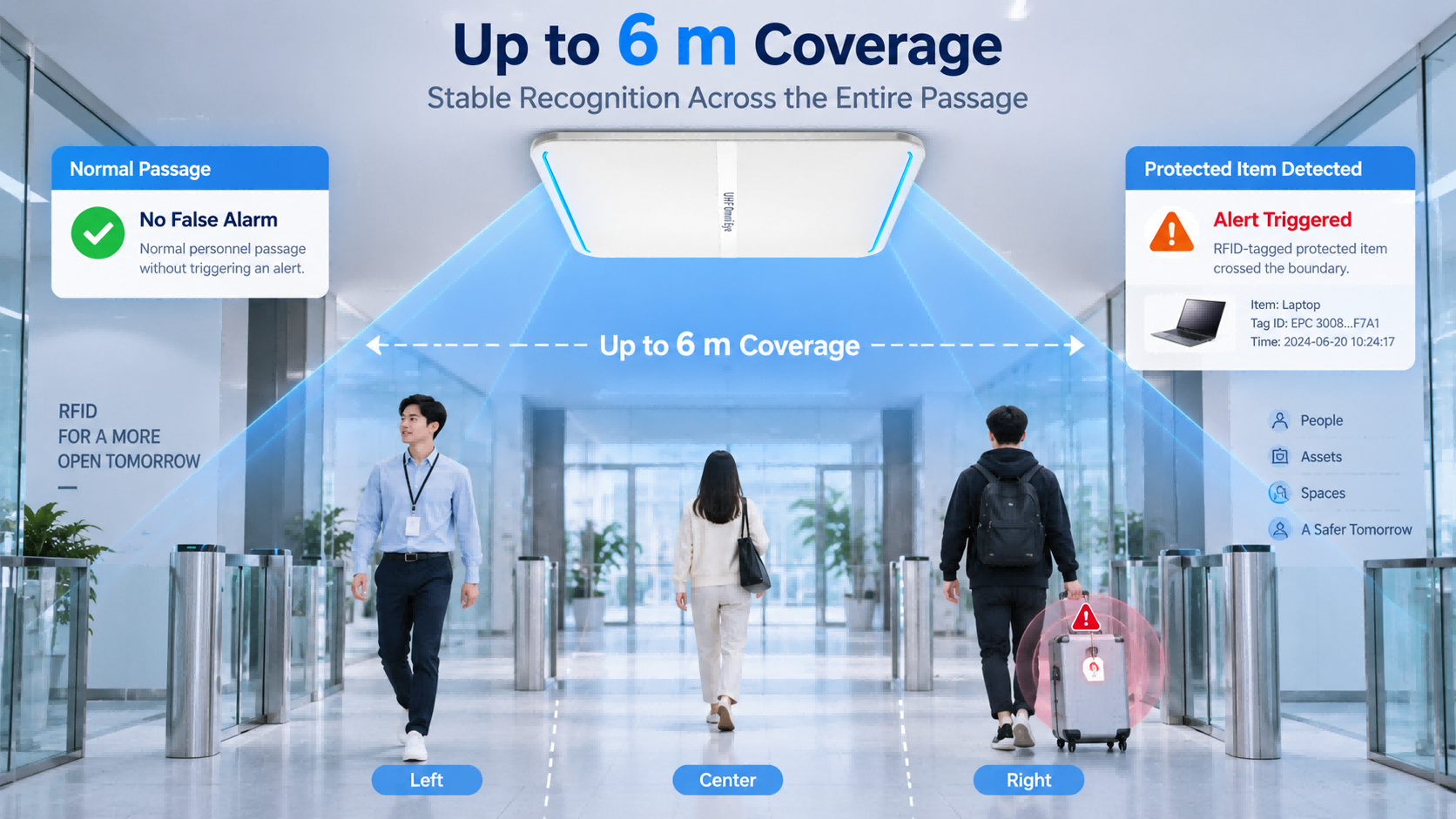
The upgraded Omni-Eye configuration adds two auxiliary units, one on each side of the main device.
This extends the effective monitoring width to up to 6 meters.
During testing, the system was evaluated at the:
of the monitored entrance.
Normal personnel passing through did not trigger valid tag alarms, while protected RFID-tagged items crossing the boundary activated the sound and light alarm. When the item was moved back, the alarm was automatically released.
This wider coverage provides more flexibility for entrances where a narrow traditional RFID gate layout may not be suitable.
The FYJ Omni-Eye RFID Gate uses an ultra-thin ceiling-mounted structure with multiple narrow-beam antennas.
Instead of placing gate panels or reader structures on both sides of the entrance, the device is mounted above the passage.
This helps:
The product supports flexible mounting methods, including ceiling and suspension installation.
The Omni-Eye RFID Gate is designed for situations where multiple RFID-tagged items may move through the monitored area at the same time.
Its AI algorithm analyzes tag movement and supports simultaneous entry and exit judgment while filtering nearby interference tags.
The system is suitable for applications where businesses need to know not only:
Which RFID tags are nearby?
but also:
Which tagged items actually crossed the boundary, and in which direction?
That distinction is especially important in access monitoring, automatic inbound/outbound identification, and RFID anti-loss applications.
The Omni-Eye RFID Gate integrates sound and light alarm functions.
When a protected RFID-tagged item crosses the defined monitoring boundary, the system can immediately trigger an alert.
Once the item returns to the permitted area, the alarm can be released automatically.
This makes the device suitable for scenarios where unauthorized movement of tagged goods, equipment, files, or assets needs to be detected quickly.
| Specification | Details |
| RFID Frequency | 840–960 MHz |
| RFID Protocol | EPC C1G2 / ISO18000-6B/C |
| Recognition | Phase trajectory recognition |
| Multi-Tag Support | Yes |
| Entry / Exit Judgment | Simultaneous direction recognition |
| Interference Filtering | Supported |
| Standard Monitoring Width | Up to 3 m |
| Expanded Monitoring Width | Up to 6 m |
| RF Power | 0–33 dBm |
| Communication | Ethernet, optional Wi-Fi |
| Protocols | TCP / HTTP / MQTT |
| Installation | Ceiling / suspension mounting |
| Operating Temperature | -20°C to 60°C |
| Device Size | 564 × 445 × 43 mm |
The product page also specifies a reading capability of more than 500 tag reads per second, with actual performance depending on tag characteristics, orientation, material, quantity, and movement conditions.
The FYJ Omni-Eye RFID Gate supports:
It can also support centralized device management through MQTT, enabling multiple RFID gates to be monitored or configured through a connected system.
For system integration and secondary development, the product supports SDK-based development, including Java and C#.
This allows the RFID gate to become part of a larger:
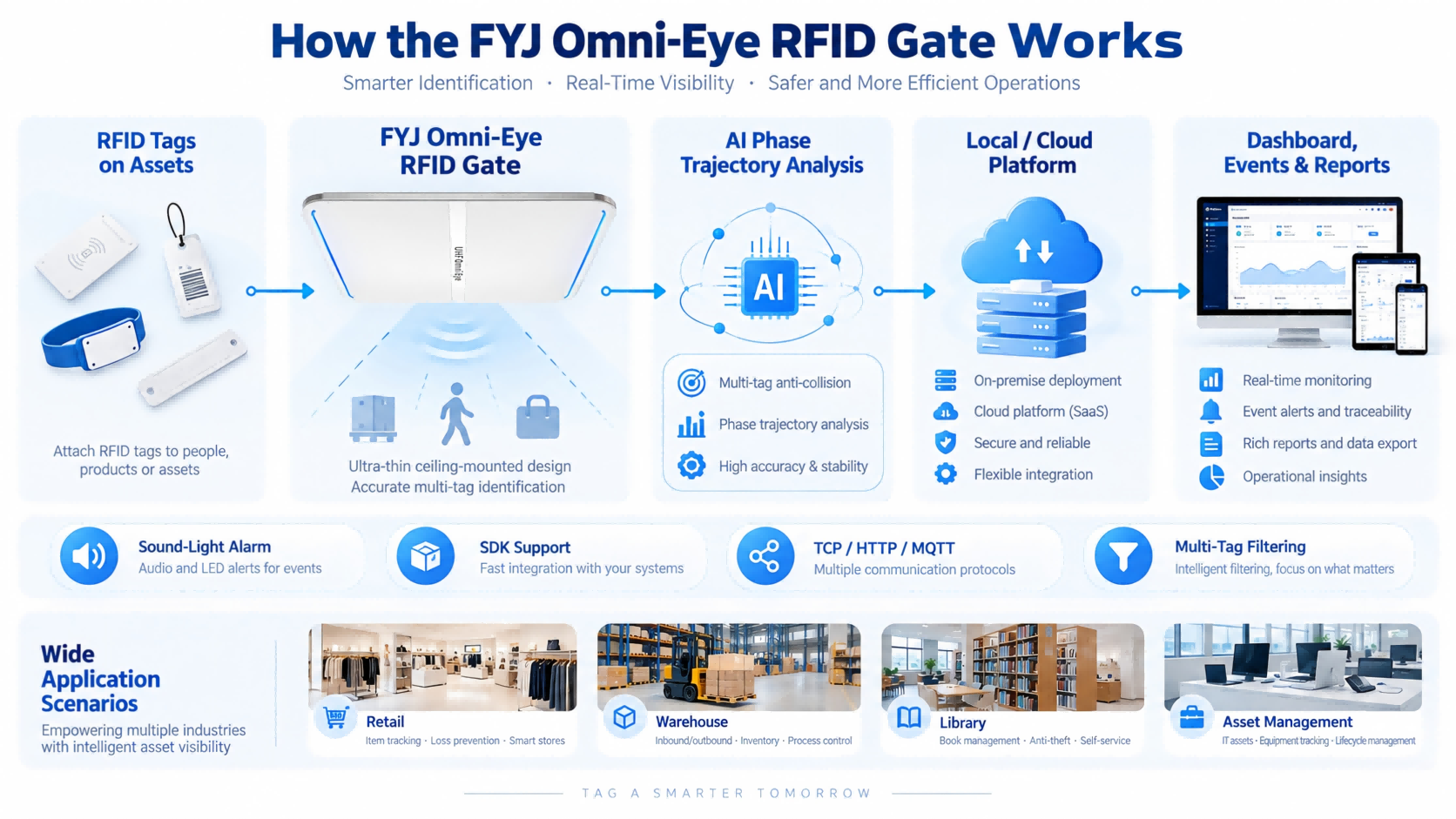
The Omni-Eye RFID Gate can be used in RFID entry and exit monitoring scenarios such as:
The underlying product information also identifies retail, power, warehousing, logistics, healthcare, libraries, archives, and asset management as applicable scenarios.
RFID gate performance is not only about reading distance.
Installation and commissioning can become a major part of project delivery.
If every entrance requires repeated adjustment after installation, deployment becomes more time-consuming and harder to standardize.
The FYJ Omni-Eye RFID Gate takes a different approach.
Because entry and exit recognition is based on tag movement trajectory rather than relying mainly on environment-specific signal thresholds, the system reduces the need for repeated onsite tuning.
For multi-site RFID projects, this can be particularly valuable.
A system that is easier to install and reproduce across different locations can reduce deployment complexity without changing the basic workflow.
The new FYJ AI-powered Omni-Eye RFID Gate expands our RFID access monitoring portfolio with a more intelligent way to recognize item movement.
Its core advantages include:
Instead of simply detecting RFID signals near an entrance, the Omni-Eye RFID Gate focuses on a more practical question:
Did the tagged item actually cross the boundary?
For RFID projects involving automatic inbound/outbound identification, asset movement monitoring, retail anti-loss, warehouse access control, or material tracking, this provides a more flexible approach to RFID entrance monitoring.
Hi! Click one of our members below to chat on
 es
es 


 Red IPv6 compatible