How Does RFID Checkout Work in Clothing Stores?
Nov 24, 2026
A shopper brings two black T-shirts to the counter. One is a medium, the other a large. The cashier places the folded shirts on an RFID checkout pad, and both sizes appear on screen. How did the checkout tell them apart without anyone scanning a barcode?
For the shopper, the benefit is easy to see: the clothes can stay folded. For the retailer, the more important question is whether the receipt matches what goes into the shopping bag. Two shirts at the same price can produce the right total even when the checkout records the wrong sizes.
Quick Answer
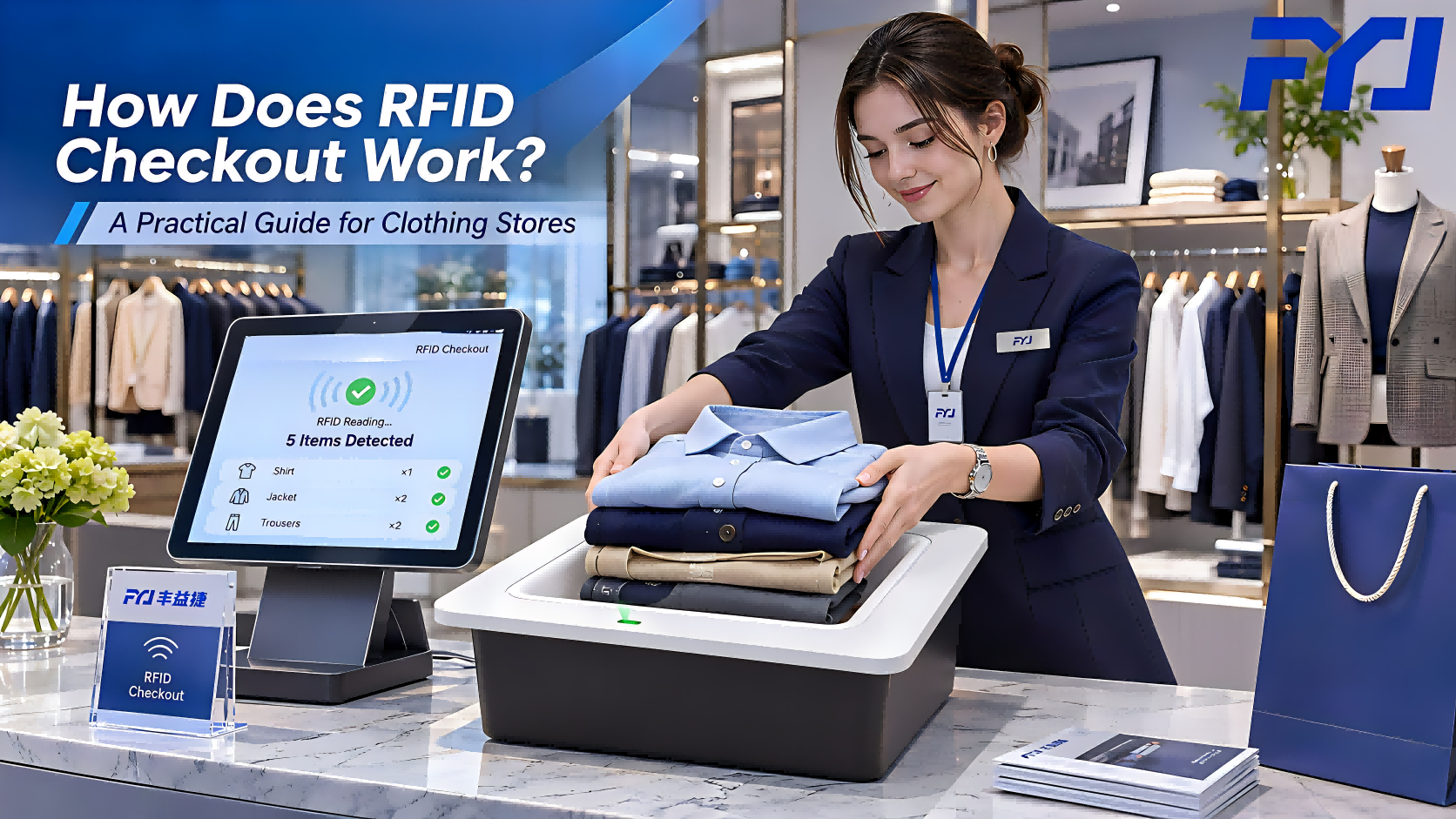
RFID checkout for clothing stores uses a reader to identify several tagged garments placed together on a checkout pad or in a basket. Each tag carries an individual identifier linked to the garment’s style, colour and size. The checkout software displays the items, the point-of-sale system (POS) applies prices and promotions, and the cashier or shopper reviews the purchase before payment.
How Does RFID Identify a Whole Basket of Clothes?
At Uniqlo, shoppers can place a basket of clothing on an RFID-enabled self-checkout kiosk. The kiosk reads the tagged garments and displays the purchase total. Customers can leave the items in the basket throughout this part of the transaction. Read Impinj’s Uniqlo self-checkout case study.
To see how the checkout knows which size to display, follow one of the black T-shirts from tagging to payment.
The retailer links a tag to the garment. Twenty black T-shirts in size M may share one stock keeping unit (SKU), while each shirt carries its own RFID identifier. That lets the checkout recognise two individual pieces when a customer buys two shirts of the same size.
The reader detects the garments together. The cashier or shopper places the clothes in the reading area. The reader collects identifiers from the tags it detects, including tags whose printed barcodes are tucked inside a fold.
The software builds the purchase list. The product record linked to each identifier supplies the description, colour and size. Repeated observations of one tag should still produce a single item in the purchase.
The cashier or shopper confirms the sale. They check the item list and total, make any corrections and proceed to payment. If the shopper decides to leave the large T-shirt behind, the revised purchase should contain only the medium.
Where Does RFID Save Time Compared With Barcode Checkout?
Watch a cashier ring up a stack of folded jeans. The barcode scan takes only a moment once the label faces the scanner. Much of the handling happens beforehand: lifting each pair, finding the hangtag, turning it over and setting the jeans down again.
RFID can shorten this item-identification stage. Several tagged garments can go into the reading area together, and the cashier can keep the stack organised while checking the purchase. A store can use this approach at a staffed till and still offer personal service, folding and gift wrapping.
The value depends on what customers usually buy. A schoolwear retailer might serve a family purchasing several shirts, two pairs of trousers and a jumper in one visit. A boutique might sell one dress per transaction and spend most of the checkout time wrapping it. The same technology addresses a different share of the wait in each store.
For a fair comparison, time garment identification, purchase review and payment separately. Also record when the counter is ready for the next customer. That last measurement captures delays that a tag-reading demonstration can easily miss.
Which RFID Checkout Setup Fits Your Clothing Store?
FYJ offers three formats for apparel retail: an RFID checkout pad, an RFID checkout basket and an RFID self-checkout kiosk. A pad and a basket describe where the garments are placed. A kiosk describes who operates the checkout and may itself incorporate a basket-style reader.
Checkout format
How it works in a clothing store
What to check before choosing
RFID checkout pad
A cashier places folded or stacked garments on a flat reading surface at an existing counter.
With your usual equipment in place, is there enough room to read the garments, fold a jacket and pack the purchase?
RFID checkout basket
A cashier or shopper places the items for one purchase in a dedicated container. Its shape gives people a visible cue about where the clothes belong.
Does your largest coat fit comfortably? Can staff see and remove an unwanted item without unpacking the whole basket?
RFID self-checkout kiosk
The shopper presents the garments, reviews the purchase on screen and follows the payment prompts.
Can a first-time user correct an item and get help? Which payment methods and receipt options are available in your market?
When comparing quotations, establish what each one covers. A desktop reader for an existing till and a complete self-service station serve different purchasing needs. Check the display, software, payment equipment and installation included in the proposed configuration.
A Thailand Retail Project With Limited Counter Space
In one FYJ project, a retailer selling clothing and jewellery in Thailand needed a Chinese- and English-language system. Space at the staffed checkout was limited. The project configuration included FYJ retail software, an RFID checkout pad and an RFID checkout basket for identifying multiple tagged items together. The retailer also needed staff to issue an order at the store and have the corresponding document print at the warehouse. Explore FYJ’s cross-border fashion retail case study.
The counter constraint is particularly useful for other retailers. A reader can fit on an empty worktop and still be awkward to use during a sale. The cashier needs somewhere to put incoming garments, somewhere to pack the completed purchase and somewhere to set aside the shirt a customer has just changed their mind about.
For a store with similar constraints, leave the payment terminal, receipt printer and shopping bags in their usual positions during the demonstration. Ask the cashier to serve two customers consecutively. The handover between purchases will show whether yesterday’s layout drawing leaves enough working space in practice.
How Accurate Is RFID Checkout? Start With the Receipt
Return to the shopper buying two black T-shirts. Both sizes have the same selling price.
What the shopper takes home
Correct receipt
Incorrect receipt
One black T-shirt in M and one in L
Black T-Shirt / M × 1 and Black T-Shirt / L × 1
Black T-Shirt / M × 2
Both receipts show two shirts at the same total. If the completed sale is posted to inventory, the incorrect transaction deducts two medium shirts and leaves the large shirt on record. Later that afternoon, a colleague may tell another customer that a large is available even though it has already left the shop. The same mismatch can surface during a stocktake. See what affects RFID inventory accuracy in apparel stores.
When a receipt is wrong, the type of error tells staff where to look:
What appears on screen
What to check first
A garment is missing.
Inspect its tag and try the garment on its own. If it still cannot be read, use the store’s agreed barcode or product-lookup procedure.
A garment appears in the wrong size.
Compare its physical size label with the product record linked to its RFID identifier. Changing reader power cannot correct an incorrect product association.
An extra garment appears.
Identify the extra item and where it was when it entered the list. Check the counter edge, the returns tray and the next customer’s waiting position.
Can the Reader Pick Up the Next Customer’s Clothes?
Yes. A nearby tagged garment can be detected if it falls within the effective reading area. A basket gives shoppers a visible place to put their clothes, while the equipment and its configuration determine which tags can enter the purchase. GS1 US discusses this requirement in its guidance on reading a basket of products at checkout. Read the GS1 US point-of-sale guide.
A useful test takes two people. Have the first present a known purchase. Ask the second to stand where customers normally queue, holding a tagged coat. Check the first purchase line by line. Then repeat with the coat resting on the counter edge, as it might when the second shopper reaches for a wallet.
If the coat appears, record where it was and when it entered the purchase list. That gives the supplier a condition to reproduce. It also helps the retailer decide whether moving the queue marker or returns tray would solve the problem with less disruption.
Is RFID Checkout Worth the Investment?
Start with three figures from your store: average items per purchase, transactions during the busiest hour and time spent finding and scanning labels. Together, they show how often batch identification could help and whether it addresses the point where a queue actually builds.
Suppose a pilot measures an average saving of 15 seconds per transaction across 240 daily purchases. That adds up to 60 minutes of checkout time per day. This is an illustrative calculation. Its value depends on when those minutes are recovered. During a Saturday rush, they may allow staff to serve more customers at the existing counter. During quieter periods, they may give staff more time to help shoppers choose a size.
A cost estimate should also reflect the store’s starting point:
Cost area
What to include
Equipment and setup
The reader or kiosk, counter changes, installation, configuration and any additional payment or receipt equipment.
Garment tagging
Which items already arrive with suitable RFID tags, which need tags applied in-store, and the ongoing cost of labels and labour.
Software and support
Retail software, applicable licences, staff training and ongoing support. Confirm compatibility separately if retaining an existing POS.
Daily operations
Staff time spent resolving unreadable tags, correcting purchases and helping first-time kiosk users.
A store already tagging garments for stocktaking starts from a different cost base than one introducing RFID solely for checkout. Use your own tag coverage and measured transaction times when comparing the options.
What Should You Test in a One-Counter Pilot?
FYJ’s iShop retail software and checkout equipment can be evaluated using the retailer’s own product catalogue and garments. Choose one working counter, keep neighbouring merchandise in its usual position and prepare a known item list for each test. This lets the store compare each receipt with the actual purchase.
Test purchase
What a successful result looks like
Two black T-shirts in the same style, one in size M and one in size L
Both sizes appear correctly, with one piece of each.
Two pieces of the same style, colour and size
The purchase shows two pieces. Reading the same pile again leaves the quantity at two.
A bulky coat, a small accessory and one unreadable tag
Staff can identify the missing item, use the agreed fallback and finish the sale accurately.
A promotional purchase with one garment removed
The unwanted item is removed, the promotion is recalculated where applicable, and the displayed total matches the receipt.
Two customers waiting at neighbouring checkout positions
Each customer’s receipt contains only the garments presented for that purchase.
A first-time shopper using self-checkout
The shopper can review the items, correct a mistake, complete payment and find assistance when needed.
Record receipt accuracy, full transaction time and staff assistance. Keep a short note on each intervention. “The cashier moved the returns tray twice to keep it out of the reading area” gives a store manager a concrete layout decision before rollout.
Frequently Asked Questions
Does RFID checkout charge the customer as soon as the clothes are detected?
In the checkout process described here, tag detection builds the purchase list. Payment takes place after the cashier or shopper reviews the items and proceeds through the store’s payment process.
Can RFID checkout read folded or stacked clothes?
Yes. Tagged garments can be identified together without exposing each printed barcode. Tag placement, garment arrangement and the reading setup affect the result. A stack of your own jeans or knitwear makes a useful demonstration basket.
Can a store use RFID and barcodes in the same purchase?
Yes, if the POS supports both input methods. Test a purchase containing RFID-tagged clothing and an accessory with only a barcode. Check that each physical item appears once on the final receipt.
Can a clothing retailer keep its existing POS?
Compatibility depends on the POS version, supported interfaces and proposed equipment. Ask to see a standard sale, a promotional purchase and an item cancellation using your product data. Those three transactions reveal more than a demonstration that simply displays tag identifiers.
Does a small boutique need a self-checkout kiosk?
A boutique can retain its cashier service and use a desktop pad or basket. A kiosk is worth considering when customers are expected to operate the checkout themselves and the store has a clear way to assist them.
How does RFID checkout relate to the security gate at the exit?
Where the two systems share sale-status information, an exit-control system can use that status when a tagged garment passes through the doorway. During a pilot, test both a successful payment and a cancelled transaction so staff know what to expect in each case.
For a final acceptance test, bring a typical Saturday purchase to the pilot and compare the receipt with the clothes in the bag.
LEER MÁS


 es


 Red IPv6 compatible