

RFID Asset Tracking System Selection Guide: How to Choose the Right RFID Solution for Your Business (2026)
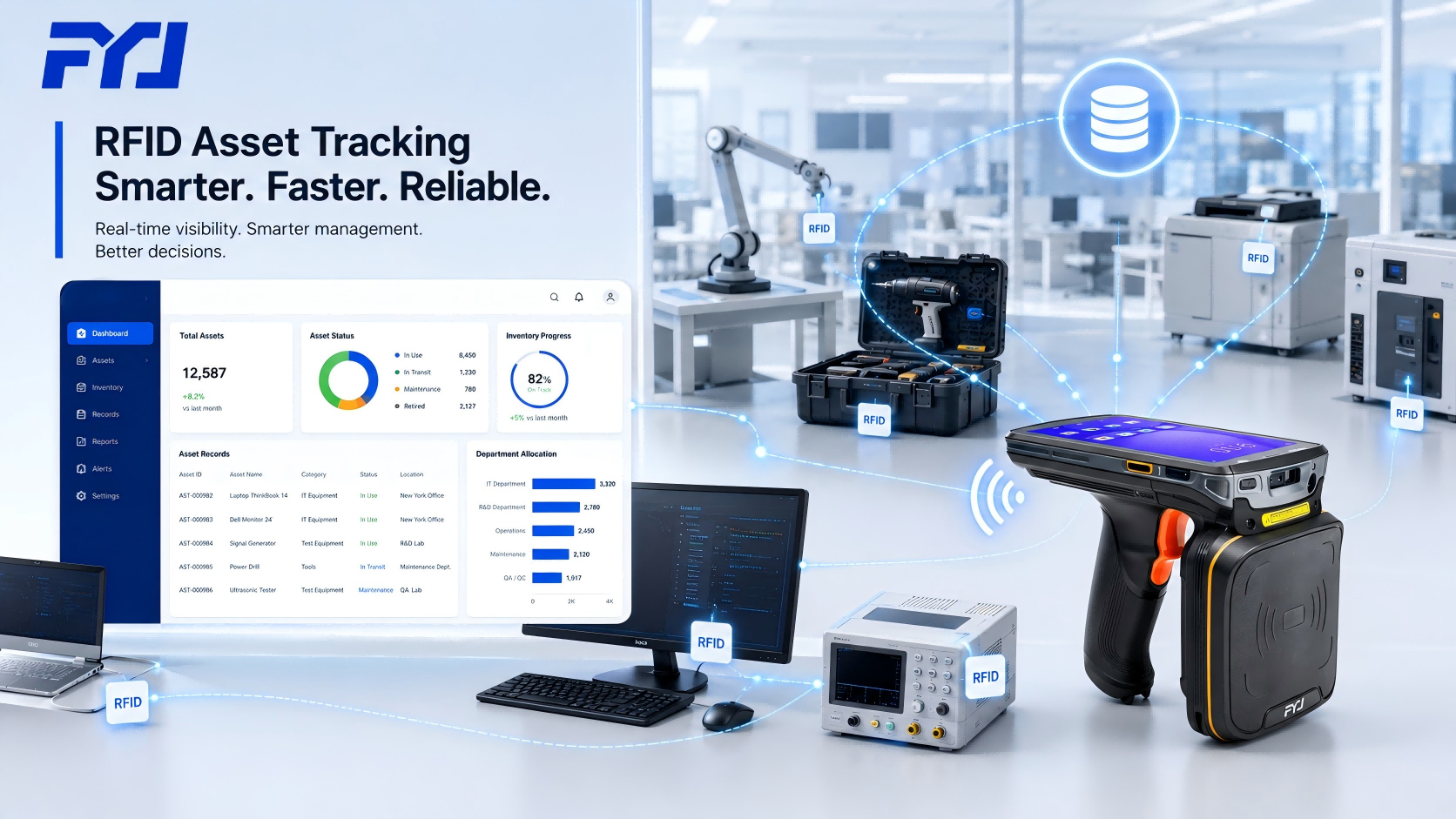
An RFID asset tracking system connects physical assets with digital records through RFID tags, RFID readers, handheld devices, and asset management software.
When selecting an RFID solution, companies should focus on several practical questions:
The best RFID system is not always the most advanced one. In many cases, the best choice is the solution that fits the company’s actual workflow and management needs.
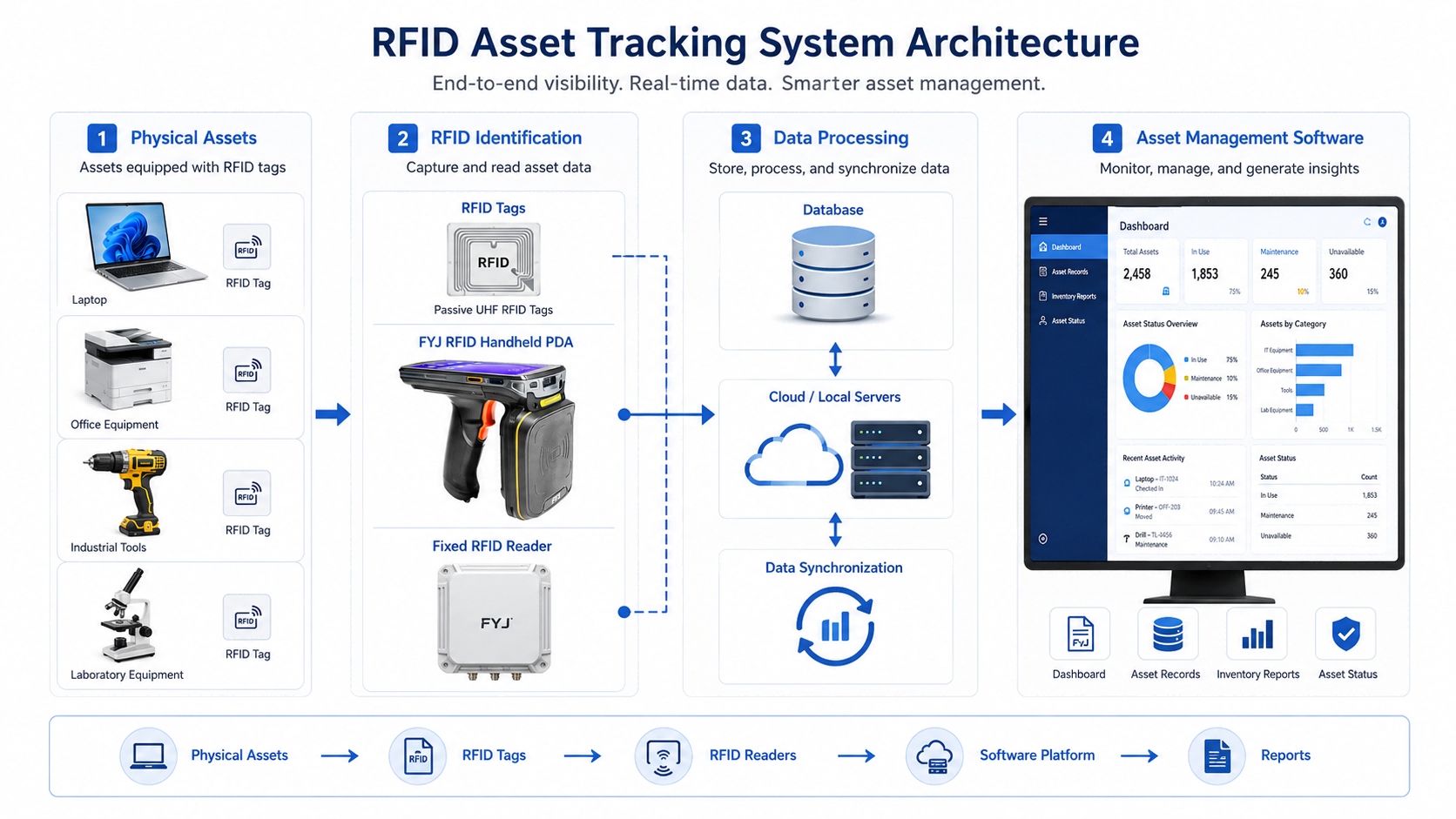
An RFID asset tracking system gives physical assets a digital identity.
Each asset is attached with an RFID tag. RFID readers or handheld devices collect information from those tags, and asset management software stores and organizes the data.
A complete RFID asset tracking system usually includes:
RFID Tags
Tags are attached to physical assets and store unique identification information.
RFID Reading Devices
Devices such as RFID handheld PDA terminals and fixed readers collect asset information during inventory or movement.
Asset Management Software
The software manages asset records, inventory results, transfer history, user responsibility, and reporting.
Together, these components help companies answer questions that are difficult to manage through spreadsheets or manual records:
RFID asset tracking is commonly used in:
Most companies do not adopt RFID simply because they want new technology.
They usually have a practical problem first.A manufacturing company may have thousands of tools and production assets. The equipment is there, but inventory teams spend too much time checking locations manually.
A large organization may know how many computers or devices it owns, but after years of employee changes, asset ownership records become difficult to maintain.
A warehouse may have accurate stock data but still rely heavily on manual counting.At a smaller scale, spreadsheets and barcode systems can work well.
The challenge appears when asset numbers increase, multiple departments become involved, or inventory takes too much time.That is usually when companies begin evaluating RFID.
From FYJ’s experience working with manufacturing, enterprise, warehouse, and institutional applications, RFID projects are rarely difficult because of the technology itself.
The harder part is designing a system that matches daily operations.Before selecting hardware, companies should understand three things:
What assets need to be tracked?
A metal production tool, a laptop, and a textile item may all require different RFID solutions.
How are assets managed today?
Some companies mainly need faster inventory.
Others need better transfer records, clearer responsibility tracking, or improved visibility across multiple locations.
How much automation is actually needed?
Not every company needs fixed readers everywhere.
Some projects can achieve significant improvements with RFID handheld PDA devices alone, while others benefit from automatic identification at entrances or controlled areas.
A successful RFID project starts with understanding the business process, then selecting the technology.
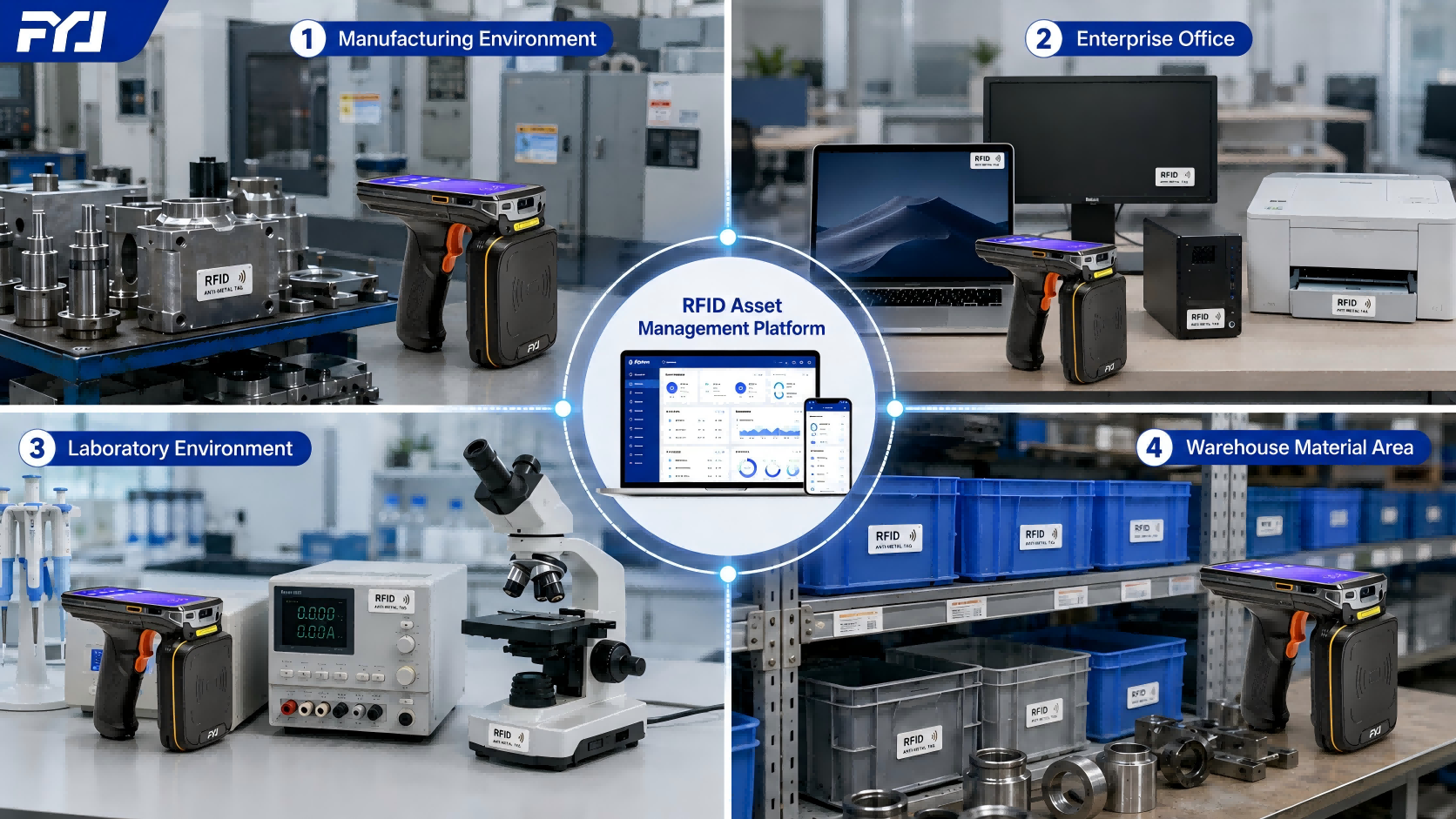
One of the most common mistakes in RFID projects is selecting equipment before understanding the assets.
The first question should not be:
“Which RFID reader should we buy?”
It should be:
“What kind of assets are we trying to manage?”
Manufacturing environments often include:
Metal surfaces can affect RFID performance, so these applications often require:
The tag choice matters because a label that works well on plastic may not perform the same way on metal equipment.
Office and IT assets usually include:
The main requirements are often:
A typical setup combines RFID asset tags, handheld RFID PDA devices, and asset management software.
Some organizations manage high-value equipment such as:
These assets often require:
Compact RFID tags and detailed lifecycle management are commonly used in these environments.
A manufacturing company managed around 3,000 production assets.
Many assets were metal equipment, which made traditional identification methods less reliable.
The project used:
After deployment:
The main lesson was simple: RFID performance starts with choosing technology that matches the asset environment.
After understanding the asset environment, the next step is deciding how RFID should work in daily operations.
A common assumption is that RFID projects always require a large number of fixed readers and complex infrastructure.
In reality, many companies start differently.
Some need a handheld RFID PDA for regular inventory. Some need fixed readers because assets frequently move through specific locations. Others combine both approaches.
The hardware should match the workflow, not the other way around.
A typical RFID asset tracking system includes four main hardware components:
| Component | Purpose |
| RFID Tags | Give each asset a unique digital identity |
| RFID Handheld PDA | Support mobile inventory and asset verification |
| Fixed RFID Readers | Automatically capture asset movement in specific areas |
| RFID Printers | Create and encode RFID labels |
Each component solves a different operational problem.
RFID tags are the connection between physical assets and the digital system.
Many companies focus on reader performance first, but the tag selection often has a bigger impact on project results.
The same RFID reader may perform differently depending on:
Common RFID tag types include:
Suitable for:
These tags are designed for situations where ordinary RFID labels may not work reliably on metal surfaces.
Suitable for:
They are commonly used for enterprise asset tracking where environmental conditions are relatively simple.
Suitable for:
Their flexible design makes them easier to apply in different scenarios.
Suitable for:
They are often used in industries where assets are frequently collected, distributed, and returned.
One thing we often see in projects is that companies compare RFID tag prices before understanding the application.
The lowest-cost tag may not be the most economical choice if it creates reading issues after deployment.
The better approach is to choose a tag based on how the asset is used.
This is one of the most common decisions during RFID system planning.
The answer depends on how assets move.
A handheld RFID PDA is usually suitable when employees need to actively perform inventory tasks.
Typical applications:
The main advantage is flexibility.
Employees can move through different areas, collect asset information, and compare physical assets with system records.
For many companies starting an RFID project, handheld PDA devices are a practical first step because they improve inventory efficiency without requiring major infrastructure changes.
Fixed readers are better suited for automatic identification at specific locations.
Common applications:
They are useful when companies need to record asset movement automatically without relying on manual scanning.
Many enterprise RFID projects use a combination of handheld and fixed devices.
For example:
This approach provides automation where it creates the most value while keeping daily operations flexible.
A tool rental company managed equipment including:
Before RFID, equipment borrowing and return records relied heavily on manual registration. When equipment moved between users, confirming responsibility became difficult.
The solution included:
After deployment:
The biggest improvement was not only faster inventory. The company gained clearer visibility into who used each piece of equipment and whether it had been returned.
RFID hardware collects information.
Software turns that information into something companies can actually use.
A reader can tell the system that an RFID tag was detected. But daily management requires more answers:
This is where the software layer becomes important.
A complete system should support the asset journey from registration to retirement.
Common functions include:
Important functions include:
This helps companies reduce the gap between physical assets and system records.
For many organizations, knowing where an asset has been is as important as knowing where it is now.
Useful records include:
Management teams often need visibility into:
A mistake we often see is that companies spend too much time comparing RFID devices and too little time reviewing the software workflow.
The hardware collects data.The software helps teams manage that data.Both parts need to work together.
Different organizations have different IT requirements.
A multi-location enterprise may prefer cloud access, while an organization with strict internal network requirements may need local or offline deployment.
The deployment method should fit the operating environment.
| Deployment Method | Suitable For |
| Cloud | Multi-location organizations requiring remote access |
| On-Premise | Companies requiring local system control |
| Offline | Organizations requiring independent internal operation |
Cloud Deployment
Suitable for:
This approach is often used by organizations managing assets across different locations.
Suitable for:
Some organizations require the system to operate independently from external networks.
Typical scenarios include:
A confidential organization managed more than 8,000 assets across multiple departments.
The organization required the system to operate within an internal environment.
The solution included:
After deployment:
This project shows why deployment options should be considered early when selecting an RFID system.
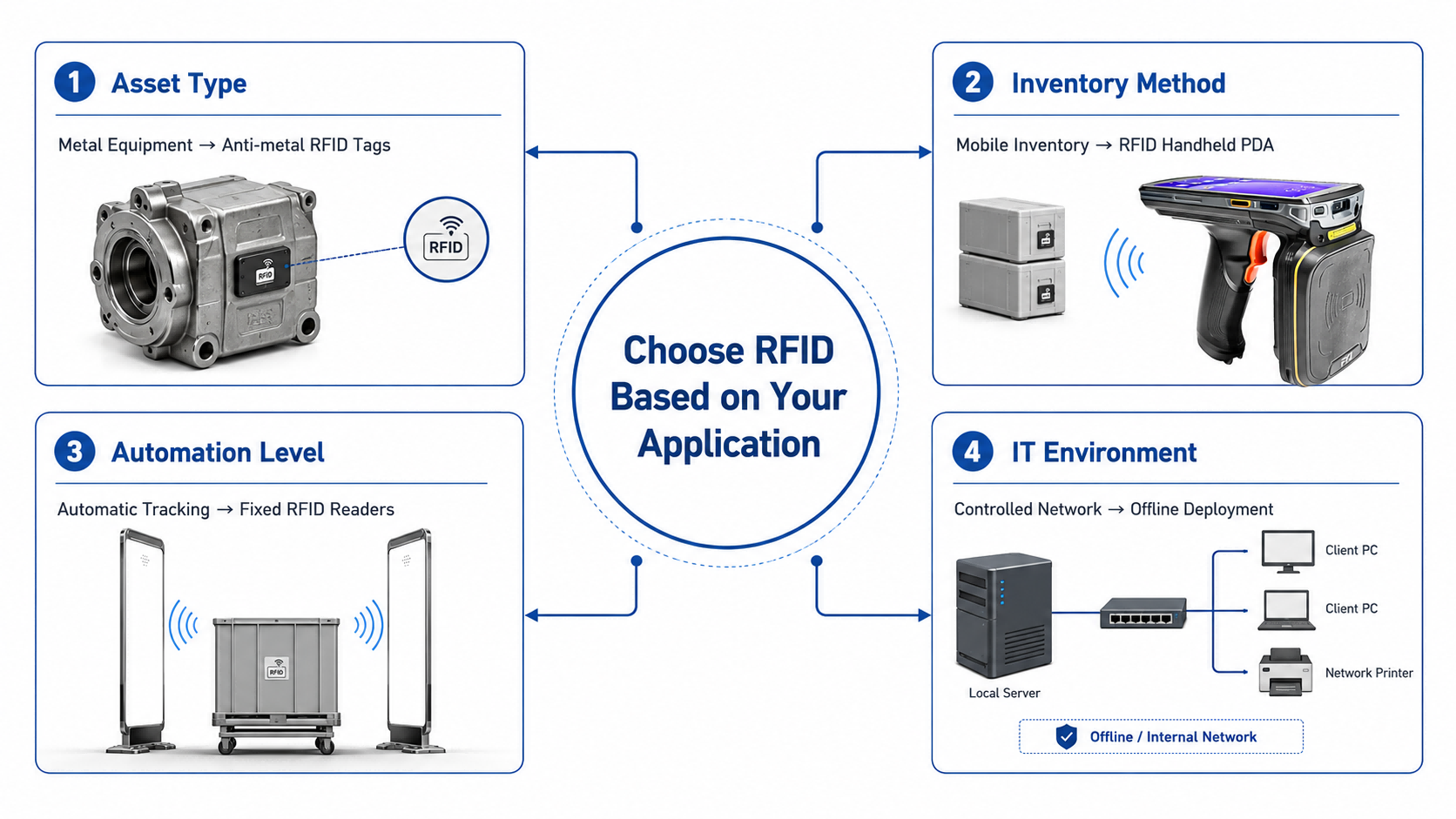
Different business situations require different RFID configurations.
| Business Situation | Recommended Approach |
| Metal equipment tracking | Anti-metal RFID tags + handheld RFID PDA |
| Large-scale inventory | RFID PDA + asset management software |
| Automatic movement tracking | Fixed RFID readers |
| Internal controlled environment | Offline deployment |
| Multiple locations | Cloud-based asset management |
| Mixed asset types | Barcode + RFID combination |
This table provides a starting point.
The final configuration should match how assets are used, moved, and managed.
RFID is not necessary for every company.
For organizations managing a small number of simple assets, barcode solutions may still be practical.
RFID becomes more valuable when companies face situations such as:
A factory checking thousands of tools every month has a different need from a small office managing several hundred laptops.
The question is not whether RFID is better.The question is whether the current management process has become inefficient enough that RFID can create measurable value.
A practical RFID project usually follows several stages.
Before selecting equipment, companies should understand:
This stage determines:
Before full deployment, companies usually test:
A small pilot project can reveal problems that are difficult to identify during planning.
The final stage includes:
A well-planned rollout usually makes long-term adoption easier.
FYJ provides RFID asset tracking solutions combining software, hardware, and implementation experience
With experience across manufacturing, enterprise, warehouse, and institutional applications, FYJ helps companies build RFID systems based on their actual asset management requirements.
What is the best RFID asset tracking system?
There is no single RFID system that fits every organization.
A manufacturing plant tracking metal tools may need a different setup from an office managing laptops.
The right choice depends on asset types, workflows, and management goals.
How do I choose RFID tags for asset tracking?
The tag should match the asset environment.
Examples:
Do I need handheld RFID PDA or fixed RFID readers?
Handheld RFID PDA devices are suitable for mobile inventory and verification.
Fixed readers are suitable for automatic identification in specific locations.
Many organizations use both.
Can RFID asset tracking work offline?
Yes.Offline deployment is suitable for organizations that need systems to operate within internal networks or controlled environments.
How much does an RFID asset tracking system cost?
The cost varies depending on:
A detailed project assessment is usually needed before determining the final budget.
RFID is often introduced as a faster way to count assets.In real projects, the bigger change is usually visibility.Teams spend less time searching for information and manually checking records. Managers gain a clearer picture of where assets are, who is using them, and what condition they are in.
The technology itself is only one part of the project. The real value comes from choosing a system that matches the assets, the workflow, and the way the organization operates.
Every organization manages assets differently. The best RFID setup depends on factors such as asset type, working environment, inventory process, and deployment requirements.
If you are planning an RFID asset tracking project, FYJ can help you evaluate:
Share your asset management requirements with our team, and we can help you design a practical RFID solution based on your actual application scenario.
Contact FYJ to discuss your RFID asset tracking project.

 Get Our Newsletter
Hi! Click one of our members below to chat on
 es
es 


 Red IPv6 compatible